Uncut Sheets of 1963 Topps Football Cards
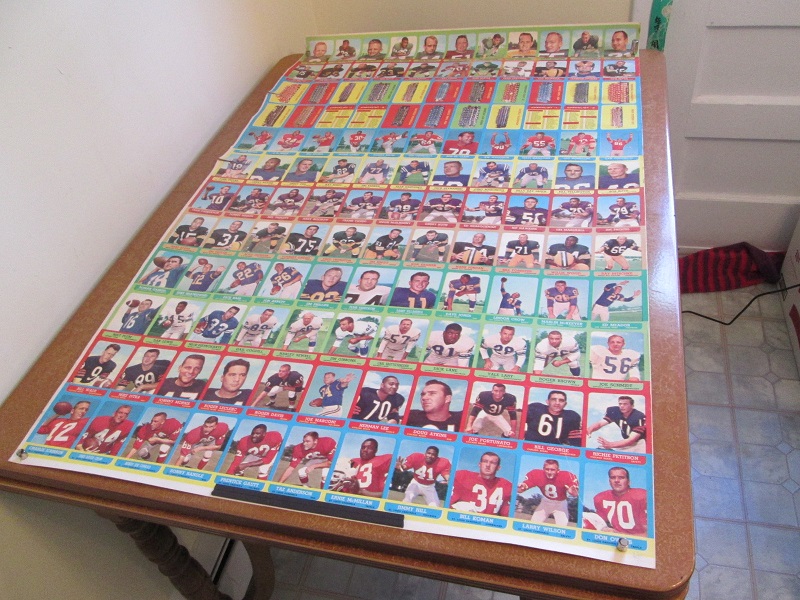
The pictures below show the approximate configuration of uncut sheets of 1963 Topps football cards. I believe that all of the player cards are in the correct places, but the order of the team cards and checklists within their rows is almost certainly incorrect, because I guessed at it. If I find a few checklists and team cards (or surrounding cards) that are badly miscut, I can put them in the correct order.
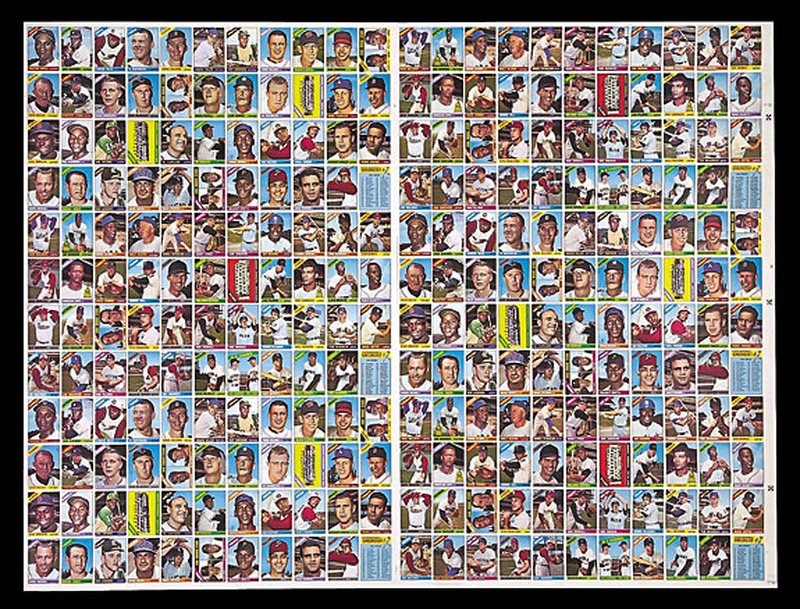
1960s Topps cards were printed on 264-card full sheets. Placed side-by-side, the two 132-card half-sheets pictured below made a full sheet. There are 170 cards in the 1963 Topps football card set, so 94 of the cards were printed twice on the full sheet, and 76 were printed once. These 76 cards are thus short prints.
Here are the observations and assumptions I made when creating the sheets:
- I assumed that the short prints listed in the price guides are correct for this set. I believe they are wrong for some sets, but in this case the short prints in the guides jibe with the grading companies' population reports, so I went with them.
- 1963 Topps cards have colored borders, and the border colors of adjacent cards have to match. For example, if a card has a yellow bottom border, the card beneath it must have a yellow top border. (For more examples of colors that continue from one card to the next, see my 1969 Topps 1st series virtual sheet.)
- All cards of players from the same team have the same two border colors. Thus, in order for their side borders to match, all of the players in a row must be from the same team.
- Teammates are grouped by number. For example, the Baltimore Colts players are numbered 1-11, and the Chicago Bears players are numbered 61-71.
- The grading companies' population reports show that the first and last player cards for each team are the scarcest. From this I surmised that the first and last players were on the edges of the sheet, where they tended to get damaged. I then assumed that the cards between were in numerical order. If you make these assumptions, a pattern emerges: a quarterback appears on the left end of each row of players, followed by the rest of the team's offensive players, followed by the team's defensive players.
- The checklists must be in the same rows as the team cards, because they are the only cards with solid blue borders. (The player cards have two colors on the borders.)
In the sheets below, if you hold your cursor above a card, your browser should show you the number of the card and the name of the player. Clicking on a card will bring up the full-sized image. The black lines between the cards would not appear on an uncut sheet; they are an effect of scanning the cards individually.
Sheet Configuration
I believe this is how the two halves of a full 264-card sheet were configured, except for the order of the checklists and team cards within their rows.
![]() |
![]() |
![]() |
![]() |
![]() |
![]() |
![]() |
![]() |
![]() |
![]() |
![]() |
![]() |
![]() |
![]() |
![]() |
![]() |
![]() |
![]() |
![]() |
![]() |
![]() |
![]() |
![]() |
![]() |
![]() |
![]() |
![]() |
![]() |
![]() |
![]() |
![]() |
![]() |
![]() |
![]() |
![]() |
![]() |
![]() |
![]() |
![]() |
![]() |
![]() |
![]() |
![]() |
![]() |
![]() |
![]() |
![]() |
![]() |
![]() |
![]() |
![]() |
![]() |
![]() |
![]() |
![]() |
![]() |
![]() |
![]() |
![]() |
![]() |
![]() |
![]() |
![]() |
![]() |
![]() |
![]() |
![]() |
![]() |
![]() |
![]() |
![]() |
![]() |
![]() |
![]() |
![]() |
![]() |
![]() |
![]() |
![]() |
![]() |
![]() |
![]() |
![]() |
![]() |
![]() |
![]() |
![]() |
![]() |
![]() |
![]() |
![]() |
![]() |
![]() |
![]() |
![]() |
![]() |
![]() |
![]() |
![]() |
![]() |
![]() |
![]() |
![]() |
![]() |
![]() |
![]() |
![]() |
![]() |
![]() |
![]() |
![]() |
![]() |
![]() |
![]() |
![]() |
![]() |
![]() |
![]() |
![]() |
![]() |
![]() |
![]() |
![]() |
![]() |
![]() |
![]() |
![]() |
![]() |
![]() |
![]() |
![]() |
![]() |
![]() |
![]() |
![]() |
![]() |
![]() |
![]() |
![]() |
![]() |
![]() |
![]() |
![]() |
![]() |
![]() |
![]() |
![]() |
![]() |
![]() |
![]() |
![]() |
![]() |
![]() |
![]() |
![]() |
![]() |
![]() |
![]() |
![]() |
![]() |
![]() |
![]() |
![]() |
![]() |
![]() |
![]() |
![]() |
![]() |
![]() |
![]() |
![]() |
![]() |
![]() |
![]() |
![]() |
![]() |
![]() |
![]() |
![]() |
![]() |
![]() |
![]() |
![]() |
![]() |
![]() |
![]() |
![]() |
![]() |
![]() |
![]() |
![]() |
![]() |
![]() |
![]() |
![]() |
![]() |
![]() |
![]() |
![]() |
![]() |
![]() |
![]() |
![]() |
![]() |
![]() |
![]() |
![]() |
![]() |
![]() |
![]() |
![]() |
![]() |
![]() |
![]() |
![]() |
![]() |
![]() |
![]() |
![]() |
![]() |
![]() |
![]() |
![]() |
![]() |
![]() |
![]() |
![]() |
![]() |
![]() |
![]() |
![]() |
![]() |
![]() |
![]() |
![]() |
![]() |
![]() |
![]() |
![]() |
![]() |
![]() |
![]() |
![]() |
![]() |
![]() |
![]() |
![]() |
![]() |
![]() |
![]() |
![]() |
![]() |
![]() |
![]() |
![]() |
![]() |
![]() |
![]() |
![]() |
![]() |
![]() |
![]() |
![]() |
![]() |
Sheet Numbering
These tables show the numbering of the cards on the sheets above. The cells in green represent the ten cards with the fewest examples graded PSA 8 or above, according to PSA's population report. (Card #61 appears on both sheets.) Cards 24 and 145 are team cards, but I don't know the order of the team cards within their rows. Because cards 24 and 145 are scarce in high grades, my guess is that they were edge cards.
| 134 | 135 | 136 | 137 | 138 | 139 | 140 | 141 | 142 | 143 | 144 |
| 1 | 2 | 3 | 4 | 5 | 6 | 7 | 8 | 9 | 10 | 11 |
| 98 | 99 | 100 | 101 | 102 | 103 | 104 | 105 | 106 | 107 | 108 |
| 86 | 87 | 88 | 89 | 90 | 91 | 92 | 93 | 94 | 95 | 96 |
| 37 | 38 | 39 | 40 | 41 | 42 | 43 | 44 | 45 | 46 | 47 |
| 25 | 26 | 27 | 28 | 29 | 30 | 31 | 32 | 33 | 34 | 35 |
| 61 | 62 | 63 | 64 | 65 | 66 | 67 | 68 | 69 | 70 | 71 |
| 85 | 170 | 48 | 60 | 97 | 109 | 12 | 36 | 72 | 84 | 24 |
| 146 | 147 | 148 | 149 | 150 | 151 | 152 | 153 | 154 | 155 | 156 |
| 49 | 50 | 51 | 52 | 53 | 54 | 55 | 56 | 57 | 58 | 59 |
| 73 | 74 | 75 | 76 | 77 | 78 | 79 | 80 | 81 | 82 | 83 |
| 158 | 159 | 160 | 161 | 162 | 163 | 164 | 165 | 166 | 167 | 168 |
| 13 | 14 | 15 | 16 | 17 | 18 | 19 | 20 | 21 | 22 | 23 |
| 110 | 111 | 112 | 113 | 114 | 115 | 116 | 117 | 118 | 119 | 120 |
| 122 | 123 | 124 | 125 | 126 | 127 | 128 | 129 | 130 | 131 | 132 |
| 145 | 133 | 121 | 157 | 169 | 85 | 170 | 48 | 60 | 97 | 109 |
| 134 | 135 | 136 | 137 | 138 | 139 | 140 | 141 | 142 | 143 | 144 |
| 1 | 2 | 3 | 4 | 5 | 6 | 7 | 8 | 9 | 10 | 11 |
| 98 | 99 | 100 | 101 | 102 | 103 | 104 | 105 | 106 | 107 | 108 |
| 86 | 87 | 88 | 89 | 90 | 91 | 92 | 93 | 94 | 95 | 96 |
| 37 | 38 | 39 | 40 | 41 | 42 | 43 | 44 | 45 | 46 | 47 |
| 25 | 26 | 27 | 28 | 29 | 30 | 31 | 32 | 33 | 34 | 35 |
| 61 | 62 | 63 | 64 | 65 | 66 | 67 | 68 | 69 | 70 | 71 |
| 146 | 147 | 148 | 149 | 150 | 151 | 152 | 153 | 154 | 155 | 156 |
Clues from Miscut Cards
Following are a few miscut cards that support the sheet configurations above.
Here is a John Brodie card with a strip of white at the top and a Charley Johnson card with a strip of white on the bottom. This indicates that the Brodie was at the top of a sheet, and Johnson was at the bottom of a sheet.
The back of a miscut Billy Ray Smith, card #9, shows a bit of Gino Marchetti, card #8, on the right. From the front, Marchetti would be on the left. The Smith card provides evidence that the player cards are in numerical order within their row.
This miscut Tom Bettis card has a bit of green at the top from the card of a Philadelphia Eagle. The Ed Brown card has a bit of yellow on the bottom from a team card. This puts the row of Steelers between the row of Eagles and a row of team cards and checklists. Also, the card below Ed Brown has to be one of the eight team cards with a yellow background.

For general information on uncut sheets of vintage football cards, see my blog article, U is for Uncut Sheets. Also see my other virtual uncut sheets, listed in the left column of this page.
Copyright 2003-2013, Nearmint's Vintage Football Cards
eBay and the eBay Logo are trademarks of eBay Inc.